
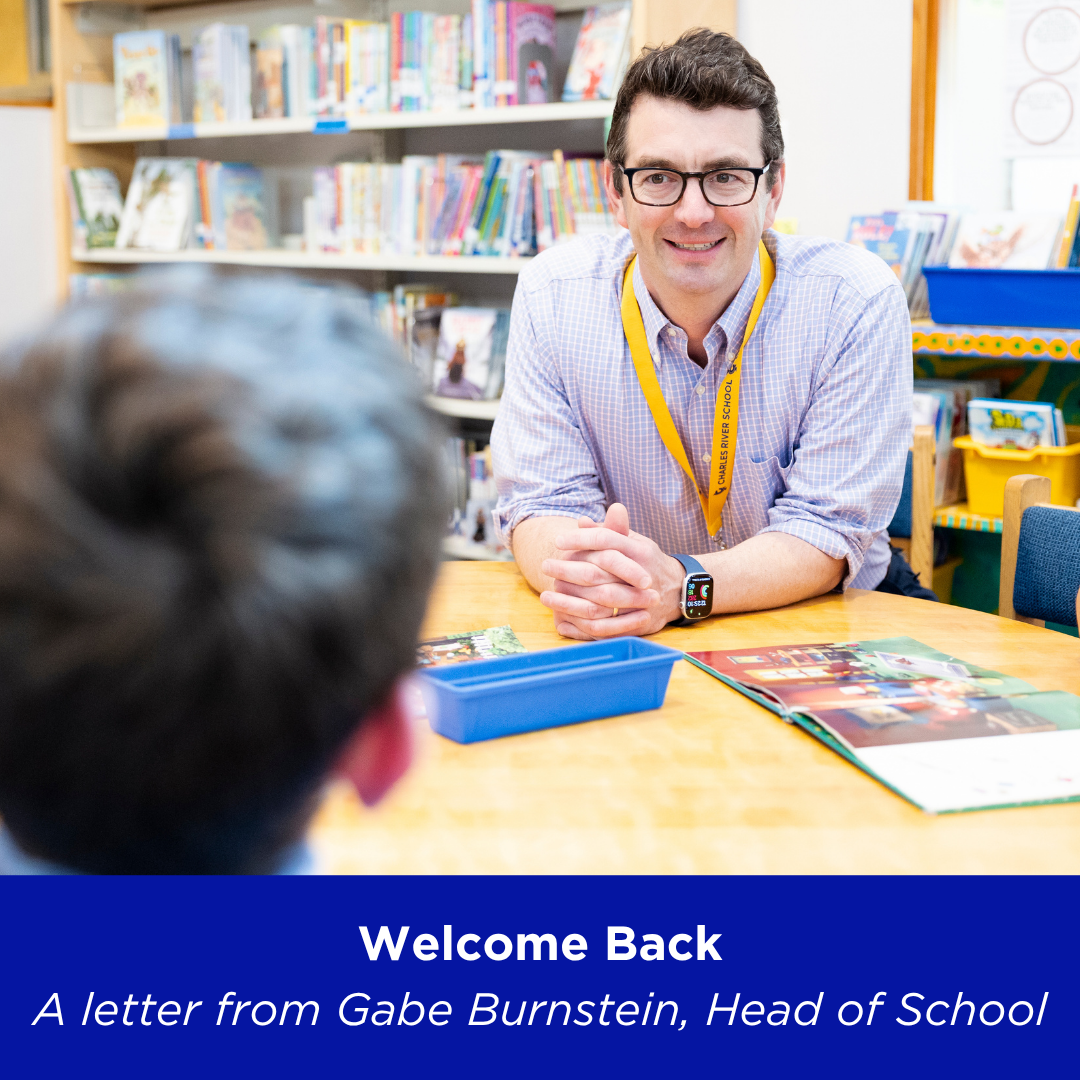
A letter from Gabe Burnstein, Head of School
Dear Charles River School Community,
Riding my bike with friends in the heat, already sticky hot at 9 in the morning, my destination was undecided. My family had no idea where I was or what time I was coming home, and it was awesome. I was with my friends, and I was free. This was also completely normal.
In these moments, for ten-year-old me, it felt like summer would last forever. Even in early August, school was a thousand years away. I had so many cannonballs left at the Central Middle School pool. There were so many fireflies to try and catch, so many Matt Christopher books left to read (IFKYK), and so many nights where my sister and I stayed up covering our mouths because we were laughing so hard and didn’t want to wake our parents. We were in sleeping bags on their bedroom floor (my father called us “rug rats”) because their room was the only one in the house with air conditioning. And while my back hurts just thinking about sleeping on the floor now, it felt special then because we only did this on those extra hot summer nights smack dab in the middle of a Michigan summer.
Time really did move differently in summer as a child. And it lasted longer.
And I know what you’re thinking: Like my son Moses who has recently taken to saying, “Okay, Grandpa,” when I tell a story from the 1980’s, what does any of this have to do with, like, modernity? You’re thinking that I might as well be describing the 1880’s when looking at childhood through a 2026 lens.
But in childhood, summer always has the potential for magic. Time still operates differently when you are four or eight or thirteen, and children feel older and like different people when they arrive back at school in September, because they are!
In the 1980’s and 90’s I undoubtedly experienced more independence as a child than many children feel today. In 2026, one of the tensions we manage as parents is how do we give our children independence and opportunities to figure things out for themselves so they can build confidence, and also keep them safe?
Two years after reading Jonathan Haidt’s The Anxious Generation, I’m still thinking about this question. His idea that collectively, American parents are overparenting in the real world, and underparenting in the digital world, has stuck with me as a parent and as a teacher. There have been many moments when I have been guilty of making this statement true in my own parental life. And other times, when I encouraged my ten-year-olds to ride their bikes to Caryl Park by themselves (this is not far) I was saddened but not surprised when a neighbor asked them if they should call the police because they were left alone by their parents.
So how do we thread the needle here?
In our house, one answer came this July in the form of a Tin Can phone, a gift from another CRS parent. This is essentially a landline that looks like a phone plugged into my parents’ kitchen wall in 1988, but it runs through the internet. It allows children to only call and be called by numbers that parents pre-program. It also allowed us to break the binary of “phone or no phone?” for families who cut the cord on landlines years ago because it’s not A PHONE. It’s just a phone.
This allowed Rebecca and me to leave our twins home alone for short periods of time. Certainly, they were much safer than I was as a helmetless, GPS-less ten-year-old in 1989. Rebecca and I locked up the ipads and remote controls, took Max out and set them up for some old school technology-less 1980’s style at home fun… and by fun I mean boredom. Which I know with certainty because they called us on the Tin Can phone 27 times to tell us now bored they were.
But boredom is great! Boredom leads to creativity and problem solving and trial and error. And folks, I am here for more boredom because it also slows down time and it resets expectations for our children (and us!) that every need will be instantly met by touching a touch screen. Because while all the touch screens in the world can make things easier, they don’t make humans happier. A quick dopamine hit disappears just as quickly and predictably as a new video pops up on the social media feed.
Happiness is actually really simple for humans – little ones and big ones too. The Harvard Study of Adult Development which started in 1938 and spanned eight decades confirmed what we have known at CRS since 1911:
Relationships predict health. Good relationships keep us healthier and happier, and quality is more important than quantity. Loneliness is toxic. Being known and loved and cared for prevents stress. Meaningful connections are what make us happy.
This famous study might as well be a description of Charles River School’s strengths: an intentionally small community for children where each child is known and loved and where being known is the foundation for joy and excellence. It is a place where the joy of childhood isn’t left behind in summer like flip flops or fireworks. Joy awaits our children on Old Meadow Road as it is inextricable from the love and the care of their teachers and classmates.
I love summer, but at heart, I’m a fall guy. I can’t wait for our teachers and children and parents to all return because that’s when the connection and joy and purpose all really intersect.
Like summer to a child, parenting years can also feel long. But at most, at CRS, we get ten of them. Ten first days of school. Ten opportunities for our children to meet their new friends and teachers for the first time. Ten Sports Days and May Days. Ten magic years.
Here’s to making this one really count.
With gratitude,
Gabe