
A letter from Corie Fogg P’34, Associate Head of School
As I look back on my first months at Charles River School, I am filled with gratitude for the welcome I have received and the clarity with which our community lives its mission. Arriving in July, I sought to understand what makes our school distinctive. In just a few months, I have seen and heard it as if it were a familiar heartbeat. Here, learning and joy are inextricably tied, and relationships are the truest, most vibrant tapestry of a child’s growth.
Joy is not an extra. Positive psychologists aim to integrate academic learning with wellbeing and character development. Felicity, curiosity, and meaning-making are essential to deep engagement, sustained motivation, and to the work of becoming. And what greater charge is there for us at Charles River School than to be known and to become? In our classrooms, on the playground, and in the everyday transitions that stitch our days together, I have witnessed joy as serious work for our students and teachers alike. For us, it is not a luxury; rather, as Cunningham and Rainville (2024) describe in their recent Educational Leadership article, joy is the oxygen for learning and growth. From morning carline dance moves to students running to a soccer game or study hall at the close of the day, Charles River School is breathing deeply!
This reveals itself in curiosity that leads to unexpected questions, in creative risks children are willing to take because they feel known, in the energy and laughter that fill the halls of our school, and in the brave self-expression of our Sharing Assemblies. I have seen our students lean in not simply for completion or compliance but for wonder and discovery.
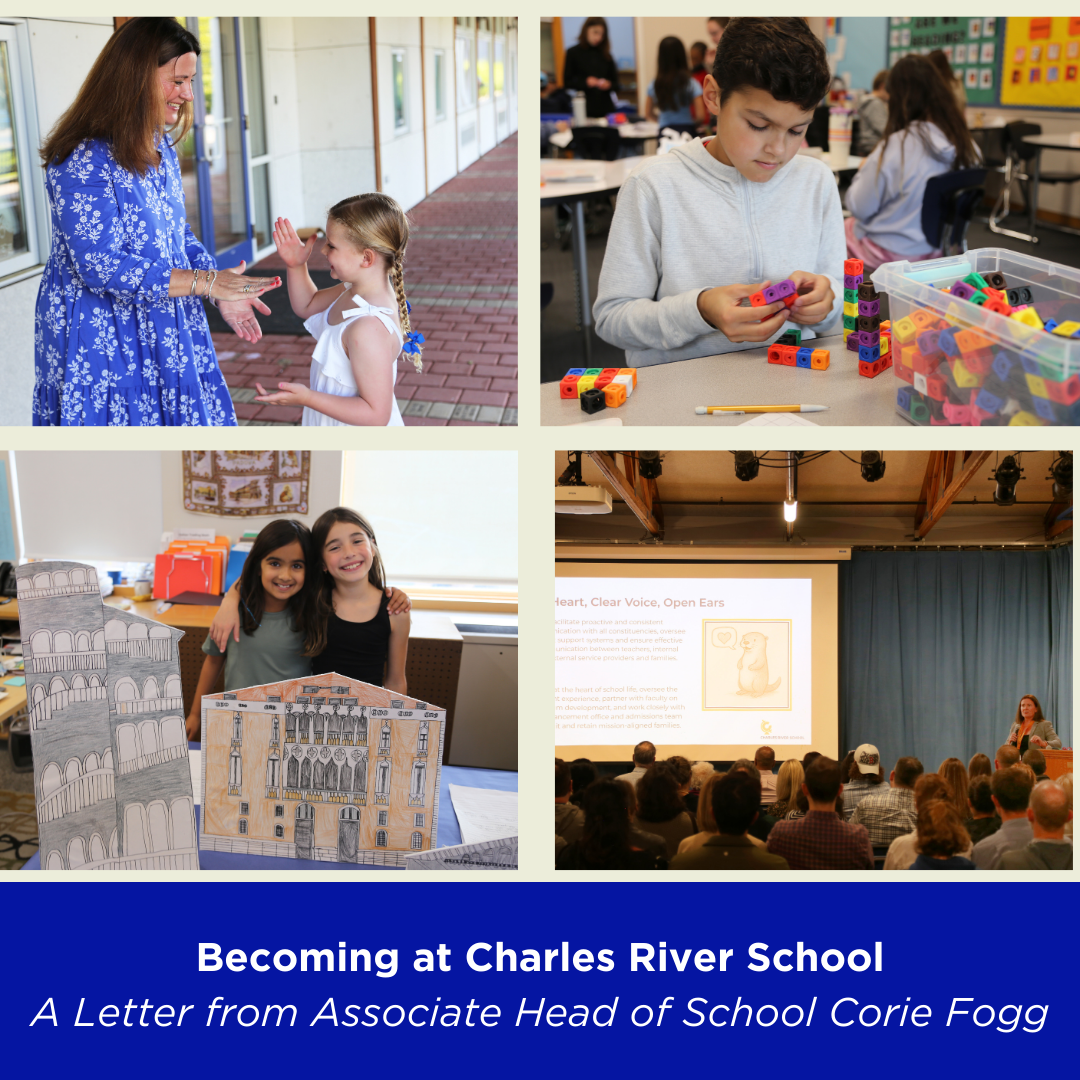
Our PreK-Grade 2 students are on a reading journey, beginning with early letter and sound formation into the purest delight that comes with reading for understanding independently. In Grades 3 and 4, students have studied and designed spaces for themselves and others – considering the very structure of their classroom to the nuanced artistry and mathematics of Venice’s Grand Canal. Grade 5 students are deep into volume – creatively naming cubic robots while exploring their spatial volume and designing expansive paper chains. Grades 6 and 7 are weaving together the complexities of power, identity, and justice in their studies as writers, historians, and scientists. And, our community leaders in Grade 8 are holding deeply the liminality of who they are here as students, athletes, artists, and friends as they concomitantly ideate on what lies ahead in the application process for secondary schools.
Such learning reflects a truth at the heart of our mission: intellectual growth and human connection are inseparable. Joy flourishes at Charles River School because children experience our campus as a place where they matter; ours is a school where their becoming is uniquely, authentically celebrated. These experiences have reminded me that joy is sustained by the relationships that surround it. Patient, child-centered, and deeply human, the care our teachers offer is what allows such vibrant learning to take shape.
Seamlessly woven into this joy is a profound commitment to care. American feminist and educator, Nel Noddings served as an elementary and high school mathematics teacher for years before embarking on a career in school leadership. Known best for her work at Stanford and Columbia, Noddings focused on moral education and ethics of care. Emphasizing the importance of relationships, empathy, and attentiveness in education, her research reveals that students thrive when they feel genuinely cared for and understood. As Noddings reminds us, “we should want more from our educational efforts than adequate academic achievement … we will not achieve even that meager success unless our children believe that they themselves are cared for and learn to care for others.”
In my early months, I have witnessed care expressed in countless small moments; many of these you also know well. An enduring sense of belonging from teachers, kind words passed in hallways, support when children take risks or struggle, giggles shared across ages 4 to 14, and the steady hum of becoming in our classrooms. These moments, knit together, shape our school where students are seen as whole people. We are learning not only content, but how to know ourselves; honor and celebrate others; and grow into compassionate, engaged citizens.
Thank you for the privilege of joining this extraordinary community and for entrusting your children to our care. Keep becoming with us; your faith and commitment to our community tie us as we move forward.
Warmly,
Corie