
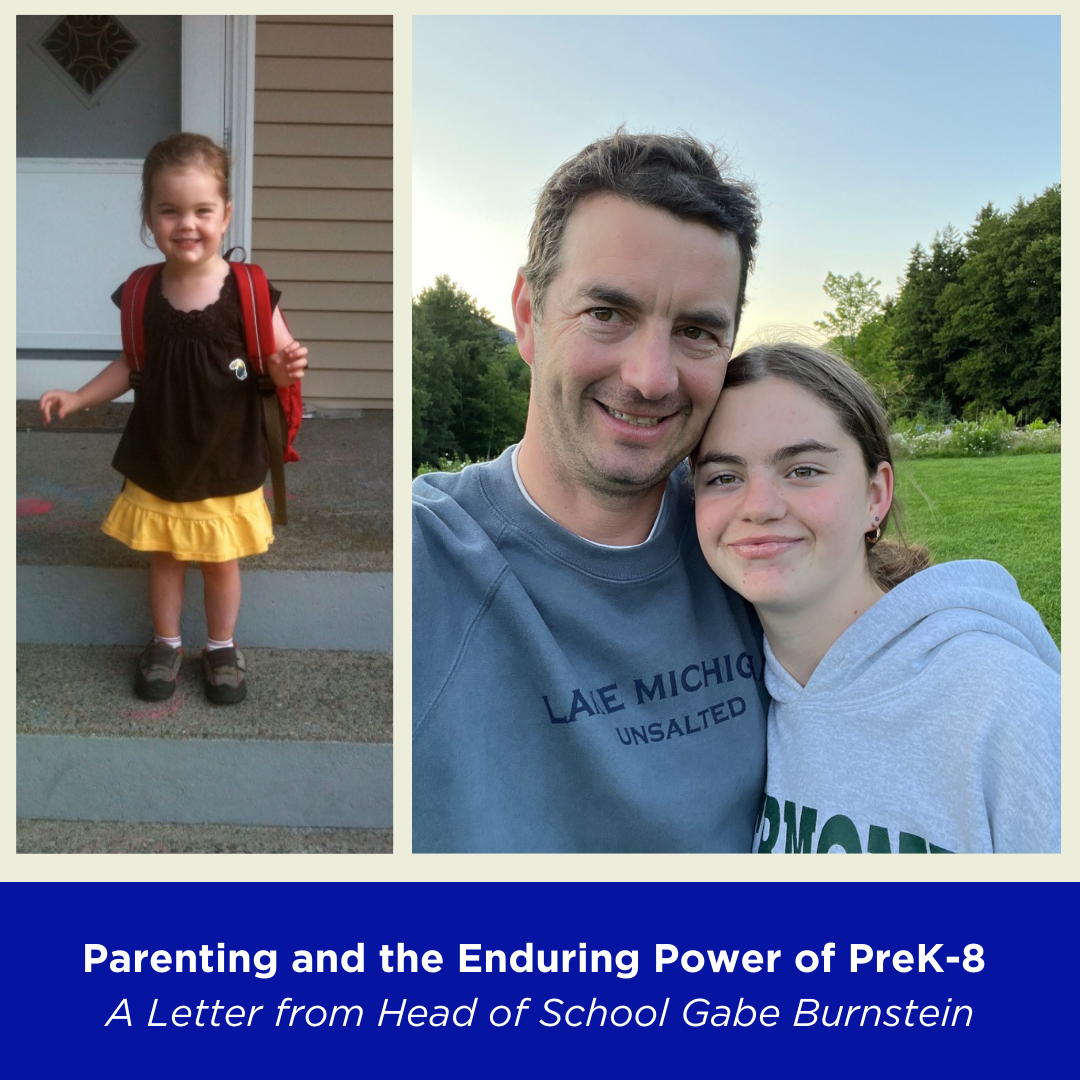
A letter from Gabe Burnstein, Head of School
I hope you all had a restorative and relaxing break with the people that you love most.
A highlight of winter break for me was spending time with my family – helping my kids build Legos, reading new books with them, and playing “around-the-world dodge ball” in the CRS gym with Moses, Juliette, Max, and Remy. It’s a pretty simple game – if you know the “around the world” shooting game in basketball, just add throwing dodge balls at your dad every time it’s his turn to shoot. In other words, my favorite present over break was just being present.
A lowlight of break, however, was when 5-year-old Max earnestly asked the family,“Who is older: Santa or Daddy?”
Considering this was said during the same month that my 18 year-old daughter Remy was accepted to college, it made me think a lot about my age and what I’ve learned as a parent.
Remy’s college process also made me reflect on my deep appreciation for PreK-8 education. The way she went about the application process and focused on her learning in her senior year was so clearly influenced by her PreK-8 school foundation. As we begin a new calendar year, I want to share with you three appreciations for the power of PreK-8 schools from this parent:
Appreciation #1: There are no high school kids
This may seem obvious, but there are no high school kids at a PreK-8 school. As Remy would say, “Bruh.” (It rhymes with “duh,” and I think it means the same thing.)
But seriously! It has been hard to watch many high school seniors feel so much stress about college. Actually, scratch seniors. It has been hard to watch so many high school kids, of all ages, worry about college and to see that energy infect younger students who share the same campus. Having started my career at a K-12 school, I have seen first hand how that stressed out energy negatively impacts middle school students in particular. By the transitive property, high school kids = stressed, which, to a 12-year-old, means stressed = cool.
This is not good. The habits of stressed high schoolers get imitated which is why I never once saw middle schoolers at a K-12 or 7-12 schools play tag or go down a slide or do anything on recess that actually resembled recess. There was no joy of childhood, because 11 and 12 year-olds were imitating 17 year-olds and carrying around habits they didn’t need or even understand.
I look back at Remy’s middle school years with such gratitude, because like our CRS 8th graders in the Class of 2026, Remy stayed blissfully ignorant of high school stress and instead remained deeply in childhood all the way to the graduation stage.
Appreciation #2: Learning for the sake of learning
The purpose of school for too many children is resume building instead of learning. And we can see it in schools where fifth graders think the purpose of fifth grade is to build a resume for ninth grade so they can, in turn, build the next resume for college. Children are taught not to be present because now is never about now. Children are taught that their current age is not as important as their future age. That’s a perfect recipe to let real academic excellence slip through their fingers, because real academic excellence is powered by intrinsic motivation and authentic curiosity.
At the same time, children need to move through school learning that everything they do is not only about excellence. Sometimes, we try new things to see if we like them, or to be with our friends, or to help us relieve stress in a healthy way. (Like “around-the-world dodge ball,” for instance.)
After submitting her college applications, Remy joined her high school’s swim team for the first time. I was not surprised. Full disclosure: Remy is a perfectly adequate swimmer. My bold prediction is that she will win zero races this year. And joining the team had nothing to do with winning races or her college application. Too many high school seniors submit applications and quickly say, “I’m done.” Because, in their mind, they are done. The college application is the finish line and the only purpose of doing anything at school is for the resume. Remy’s stance however, was to try something new because that’s always been her stance – that’s what her PreK-8 school taught her to do.
Remy joined the swim team because she said she “likes being a teammate”, she has friends on the team, and she can see the finish line of all those happy bus rides with them. With her last cross country season behind her, she wanted to make sure she was exercising, especially as she was managing the stress of the college process. I can’t tell you how much I want to hug her PreK to 8 school for helping shape her into a young person who has learned how to manage stress effectively and be unafraid to try something new regardless of performance. Those are skills learned at a PreK-8 school that will serve her far beyond college.
Appreciation #3: The high school placement process
Like many seniors who graduated from a PreK-8 school before attending an independent school for high school, Remy felt confident in the process of applying to college, because she just did it. Starting at the end of her seventh grade year, she researched schools and made a list of what she wanted out of her high school experience. Then, in the fall of her eighth grade year, she visited schools, interviewed, wrote essays, prepared for standardized tests, and was even taught how to intentionally and empathically share her news and ask her friends about their news. Finally, she made a decision about the right school for her high school years.
(This is exactly what we do at CRS for our oldest students, by the way.)
Remy was not able to engage in a process in this way as a fifth or sixth grader, and she would have picked a different school at that stage. At age 14, the end of young adolescence, she had a deeper understanding of who she was and what she wanted for her own education. She was developmentally ready and got a lot of support from her eighth grade teachers and the high school placement coordinator.
When it was time to apply to college, Remy didn’t feel the pressure or stress that so many peers felt because she had the reps in the bank and had earned confidence by going through this process once before. When it came time to write her Common App essay, she did it all on her own. I may have suggested a single comma, but that’s it, because she knew exactly what to write and how to write it. I am so grateful that her PreK-8 school gave her the experience and confidence that powered her through the college process.
Cheers to 2026
I’ve taught and led and learned in two different PreK-8 schools and these are the schools that my own children have attended. As an educator, I quickly fell in love with the PreK-8 model and firmly believe that it is the most effective structure we have created to support academic excellence and the joy of childhood. This year, as my oldest daughter begins her final semester in independent schools, I have learned a new appreciation for PreK-8 schools as a parent too.
Childhood is special and should be treated as such. Learning is about learning, and learning how to learn is a lifelong skill. At CRS, we partner – home and school, and we share these values. By putting them into practice, we empower our children, with confidence and compassion, to be the best versions of themselves.
Here’s to continuing this great group project in 2026.
With gratitude,
Gabe