
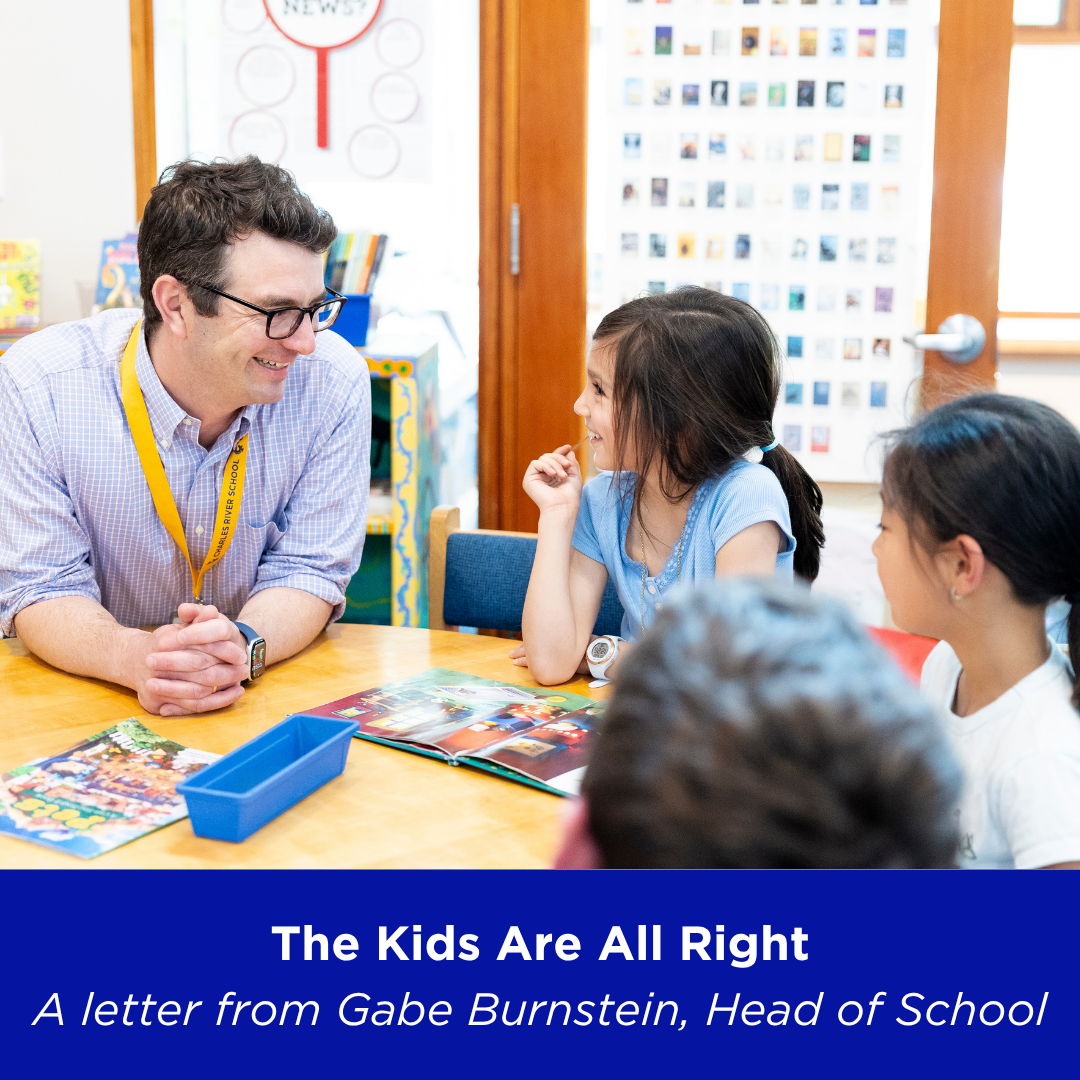
A letter from Gabe Burnstein, Head of School
There are some things at Charles River School that are changing quickly, and some things that, thankfully, never seem to change at all.
Every day at recess, rain or shine, snow or heat, there is still a line for Four Square and Wall Ball. All it takes is a simple playground ball and a few painted lines on the pavement. Or a wall.
And yet, somehow, within those simple games lives an entire education.
It is there, like in so many places across our campus, that students build friendships across grade levels, celebrate the triumph of victory, endure the agony of defeat, and engage in the extremely serious business of negotiating rules and fairness.
“Wait, that was out.”
“No, it hit the line!”
“You’re making up the rules!”
Justice. Fairness. Sportsmanship. Conflict resolution. Resilience. Relationship building. All practiced with three classmates and a ball. There is no automated ball and strike system that exists in Major League Baseball. In fact, there is no digital technology at all. But Four Square, like May Day or Sports Day, is a part of student life that graduates from the Class of 1956 would recognize immediately if they walked onto campus today. And I love that.
Because while schools must evolve to prepare children for the future, there is also something deeply reassuring about the timelessness of childhood play centered around human connection, because you can’t play Four Square alone.
At the very same time that Four Square continues uninterrupted on our playground, schools everywhere, including CRS, are actively wrestling with enormous questions about artificial intelligence. (Steve Trust, our indefatigable Director of Technology, shared an essay on this topic in the fall.)
How do we prepare students for a future where AI will undoubtedly be part of their lives and work?
How do we make sure students develop the skills and fluencies they will need to navigate a rapidly changing world?
And perhaps most importantly: how do we ensure that in embracing these new tools, we do not outsource the deeply human skills that children need to practice and master in order to make connections, build confidence, and develop their own critical thinking skills?
These are not theoretical questions for schools anymore. They are very real, present tense questions. And they are questions we are continuing to think about carefully and intentionally at CRS.
I have been experimenting with AI myself as a school leader, trying to understand where it can genuinely serve the school and where it might interfere with the essential human processes of thinking, creating, struggling, and learning.
Last week, for example, I had set aside 30 minutes to create a dashboard for a Board report about the Class of 2026’s secondary school admissions process. (Fun stat: 88% of our eighth graders were accepted to their first or second choice school.)
Tessa Steinert Evoy, our Secondary School Coordinator, gave me the data. I knew what I wanted the dashboard to communicate. And I used Claude to help me build it. It generated something. I gave feedback. Claude revised it. We went back and forth a few times. And in total, something I had budgeted 30 minutes for took about six minutes and 38 seconds.
Which meant, I got approximately 22 minutes and 22 seconds back. So naturally, I did what any self respecting CRS student would do with found time: I went to recess.
And I spent those 22 minutes playing Wall Ball with students. And Charlie R., a first grader, “cooked me” as the kids say.
So now Wall Ball and Four Square have quietly become part of my litmus test for AI: Are there tasks that can be supported by AI in ways that do not jeopardize the integrity of my creativity, thinking, or process, while simultaneously giving me more time to get off my computer and be more present with students and teachers? In this case, the answer was yes.
And so AI gave me 22 more minutes of Wall Ball. 22 more minutes of relationship building. 22 more minutes of being fully present with students in real life instead of behind a screen. That feels important, and it feels like a responsibility.
Meanwhile, one of the great gifts of my role at CRS is that I regularly get to talk with alumni and, in many ways, glimpse the future of our current students. And over and over again, I hear the same thing:
Not about test scores. Not about technology. I hear about relationships.
I hear about teachers who made students feel known and cared for. I hear about earned confidence thanks to those relationships.
This May, I met with Julius Hochberg from the Class of 2019. Julius just completed his junior year at Brown University, where he is studying physics and engineering. He told me about one-atom-thick quantum sensors. He explained something called graphene, a two-dimensional sheet of carbon atoms arranged in a repeating honeycomb lattice.
(I nodded politely and then asked a lot of questions.)
This summer, he is headed to the University of Wisconsin for a program exploring a different approach to quantum sensing using boron and nitrogen instead of carbon. Again, Julius was incredibly patient as he walked me through all of this. And eventually I asked him a simpler question: “How did you fall in love with physics?”
Without hesitation, he started talking about science classes at CRS. Teachers like the great Annie Kenney. And then he told me about a physics teacher he had later in high school. “I could tell he was holding back on us,” Julius said. “There was clearly more to know than what was in the curriculum.”
At CRS, he was taught the value of curiosity and confidence. He learned his questions were important and to feel comfortable approaching teachers (or any adults in positions of authority) and asking them. And so he did. He stayed after class, and he asked questions. LOTS of questions! And the next thing you know, he’s back at CRS teaching the Head of School about one-atom-thick-quantum sensors.
As an aside, he also told me that he is currently a teaching assistant for a computer programming course at Brown, and that each class begins with a skit he performs in to help students relax, laugh, and feel connected. (And honestly, I couldn’t help but think: How many Sharing Assemblies helped Julius earn the confidence to do that?)
Later in our conversation, we talked about AI and how universities are navigating its growing presence in academic life. And once again, Julius returned not to technology, but to values.
“Look,” he said, “when I was a freshman, AI couldn’t do my homework. Now it can.”
I asked him the obvious question: What keeps him from having AI do his homework for him? Then he said something that has stayed with me: “You have to have an understanding of why learning is important. You have to know why the act of learning for your development as a person is important. That’s what keeps you honest and motivated so you do the work that you need to do… yourself.”
That feels exactly right to me.
And so, in a world with a dizzying pace, and no shortage of major challenges, it is in playing Wall Ball with Charlie R. and in learning from alumni like Julius H., that I find myself feeling surprisingly calm and extremely hopeful about the future. Because the values our students learn at CRS are evergreen:
Relationships are important.
Curiosity is paramount.
Confidence is earned.
And the ability to collaborate with others, navigate conflict, negotiate rules, recover from mistakes, make difficult decisions, and stay deeply human in an increasingly technological world matters.
There are a myriad of problems our students will one day help solve, many we cannot even imagine yet. And they will shape our future thanks to skills and ways of being built upon timeless values that are found in CRS classrooms and playgrounds during every minute of every school day.
I can’t wait to do it again in September.